High School Students in Pécs Developing Flight-Ready Satellite Systems
What exactly is CanSat, and how can a satellite simulation built by high school students reach an altitude of 1,000 meters?
The CanSat competition invites student teams to design and build a miniaturized satellite the size of a soft drink can. The payload is launched by rocket, deployed at approximately one kilometer, and descends by parachute while transmitting environmental data collected through onboard sensors. More than a technical challenge, the program introduces students to mission planning, systems engineering methodology, verification procedures, and professional-level technical documentation.
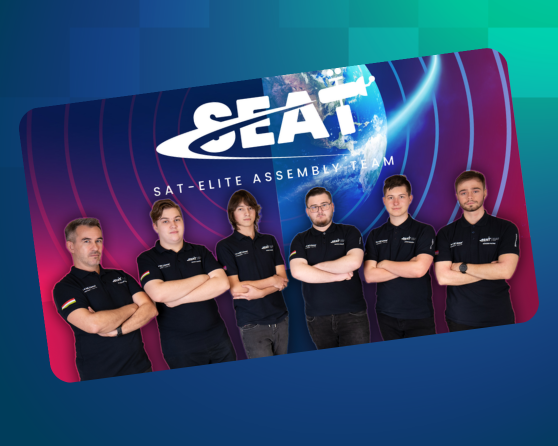
The Sat-Elite Assembly Team from Pécs has been competing for the third consecutive year in the Hungarian round organized by the Hungarian Astronautical Society as part of the European Space Agency educational initiative. Their work shows how secondary school students can approach engineering problems with the rigor and mindset typically associated with the aerospace sector.
Six Months to Deliver a Flight-Ready System
The Hungarian CanSat program has grown significantly in recent years, expanding from just a handful of teams to more than one hundred participants. Competing in such a field represents a considerable technical achievement.
Teams have six months to define mission objectives, design electronic and mechanical systems, develop embedded software, conduct validation tests, and prepare professional technical documentation. The top ten teams’ CanSats are launched to an altitude of 1,000 meters before descending safely by parachute. Following recovery, students present their flight data and system performance to a professional jury.
Recovery as a Mission-Critical Challenge
Although the launch captures the most attention, recovery often proves to be just as demanding. A descending payload released at one kilometer can drift several kilometers from the launch site depending on wind conditions. In previous competitions, some teams have spent hours locating their CanSat, and in rare cases the payload was never recovered.
To mitigate this risk, the Sat-Elite Assembly Team developed a proprietary radio and GPS-based tracking solution designed to provide accurate post-landing localization. Their goal extends beyond securing their own mission success. They are working toward a robust, reusable system that could support other teams in future competitions as well.
Integrated Hardware and Embedded Systems
Within the strict size and mass constraints defined by the competition rules, the team continuously enhances the functionality of its satellite. The current configuration incorporates thermal imaging capabilities, calibrated visible-spectrum cameras, temperature and humidity sensors, GPS positioning, and additional environmental measurement units. Structural improvements have been implemented to better withstand launch acceleration loads and landing impact forces.
Throughout the development process, team members have gained practical experience in printed circuit board design, embedded firmware development, mechanical integration, system validation, and formal engineering documentation. A comprehensive Critical Design Review video documents their progression from initial concept through subsystem integration to a flight-ready prototype, offering insight into both hardware architecture and software implementation.
From Competition to Orbit
Their achievements in previous competitions created new opportunities. In cooperation with the Budapest University of Technology and Economics, the team contributed to an experimental payload integrated into the HUNITY satellite. The satellite reached a 520-kilometer orbit aboard the SpaceX Transporter-15 mission.
The onboard experiment measures panel temperature, visible and infrared radiation levels, and attitude-related orientation parameters. The collected telemetry is transmitted to ground stations for processing and analysis, transforming classroom engineering into real orbital data acquisition.
More Than a Competition
Within the team, clearly defined roles reflect real engineering environments. Some members focus on embedded software, others specialize in electronics design, documentation, systems integration, or external communications. They actively participate in professional events and maintain a visible presence in the community, motivated by the belief that access to inspiring technological challenges can shape future career paths.
The final results will be decided in April among the top ten teams. Regardless of the outcome, supporting the Sat-Elite Assembly Team means supporting the next generation of engineers. Investing in young talent today strengthens the foundations of tomorrow’s innovation ecosystem.