


CanSat
High School Students in Pécs Developing Flight-Ready Satellite Systems
What exactly is CanSat, and how can a satellite simulation built by high school students reach an altitude of 1,000 meters?
The CanSat competition invites student teams to design and build a miniaturized satellite the size of a soft drink can. The payload is launched by rocket, deployed at approximately one kilometer, and descends by parachute while transmitting environmental data collected through onboard sensors. More than a technical challenge, the program introduces students to mission planning, systems engineering methodology, verification procedures, and professional-level technical documentation.
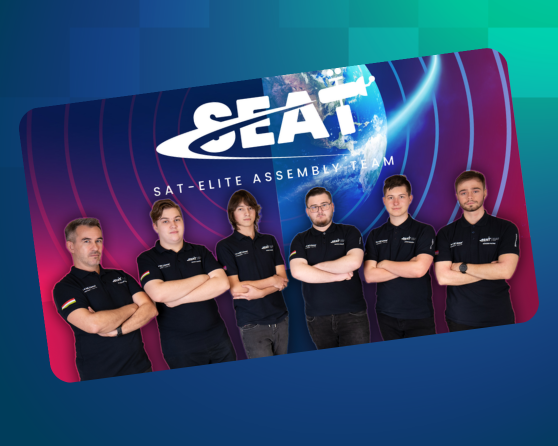
The Sat-Elite Assembly Team from Pécs has been competing for the third consecutive year in the Hungarian round organized by the Hungarian Astronautical Society as part of the European Space Agency educational initiative. Their work shows how secondary school students can approach engineering problems with the rigor and mindset typically associated with the aerospace sector.
Six Months to Deliver a Flight-Ready System
The Hungarian CanSat program has grown significantly in recent years, expanding from just a handful of teams to more than one hundred participants. Competing in such a field represents a considerable technical achievement.
Teams have six months to define mission objectives, design electronic and mechanical systems, develop embedded software, conduct validation tests, and prepare professional technical documentation. The top ten teams’ CanSats are launched to an altitude of 1,000 meters before descending safely by parachute. Following recovery, students present their flight data and system performance to a professional jury.
Recovery as a Mission-Critical Challenge
Although the launch captures the most attention, recovery often proves to be just as demanding. A descending payload released at one kilometer can drift several kilometers from the launch site depending on wind conditions. In previous competitions, some teams have spent hours locating their CanSat, and in rare cases the payload was never recovered.
To mitigate this risk, the Sat-Elite Assembly Team developed a proprietary radio and GPS-based tracking solution designed to provide accurate post-landing localization. Their goal extends beyond securing their own mission success. They are working toward a robust, reusable system that could support other teams in future competitions as well.
Integrated Hardware and Embedded Systems
Within the strict size and mass constraints defined by the competition rules, the team continuously enhances the functionality of its satellite. The current configuration incorporates thermal imaging capabilities, calibrated visible-spectrum cameras, temperature and humidity sensors, GPS positioning, and additional environmental measurement units. Structural improvements have been implemented to better withstand launch acceleration loads and landing impact forces.
Throughout the development process, team members have gained practical experience in printed circuit board design, embedded firmware development, mechanical integration, system validation, and formal engineering documentation. A comprehensive Critical Design Review video documents their progression from initial concept through subsystem integration to a flight-ready prototype, offering insight into both hardware architecture and software implementation.
From Competition to Orbit
Their achievements in previous competitions created new opportunities. In cooperation with the Budapest University of Technology and Economics, the team contributed to an experimental payload integrated into the HUNITY satellite. The satellite reached a 520-kilometer orbit aboard the SpaceX Transporter-15 mission.
The onboard experiment measures panel temperature, visible and infrared radiation levels, and attitude-related orientation parameters. The collected telemetry is transmitted to ground stations for processing and analysis, transforming classroom engineering into real orbital data acquisition.
More Than a Competition
Within the team, clearly defined roles reflect real engineering environments. Some members focus on embedded software, others specialize in electronics design, documentation, systems integration, or external communications. They actively participate in professional events and maintain a visible presence in the community, motivated by the belief that access to inspiring technological challenges can shape future career paths.
The final results will be decided in April among the top ten teams. Regardless of the outcome, supporting the Sat-Elite Assembly Team means supporting the next generation of engineers. Investing in young talent today strengthens the foundations of tomorrow’s innovation ecosystem.

BUS2BUS Roadshow
BUS2BUS 2026: Autonomous Mobility, Electrification and the Future of Bus Transport
The fourth stop of the BUS2BUS Roadshow in Berlin set the strategic tone for BUS2BUS 2026, positioning bus mobility at the center of Europe’s transport transformation. At the first Roadshow stop in Hungary and the Czech Republic, Tamás Móricz, Commercial Director of HC Linear, represented the company in a professional dialogue with an international audience. The Berlin roundtable discussion, moderated by Sustainability Evangelist and Podcast Host Zackes Brustik, brought together Kerstin Kube-Erkens, Director of BUS2BUS at Messe Berlin; Christiane Leonard, Managing Director of the Bundesverband Deutscher Omnibusunternehmen; Dr. Stefan Carsten, Futurist and Curator of the BUS2BUS Future Forum; and Maximilian Rohs, Director Infrastructure & Mobility at PwC Deutschland.
The message emerging from the discussion was clear. Buses are no longer simply a component of public transport. They are a strategic enabler of sustainable, scalable, and digitally integrated mobility systems.
Industry in Structural Transformation
The bus sector is undergoing structural change driven by three interconnected forces: decarbonization, digitalization and automation.
Fleet electrification is accelerating across European markets. Battery electric buses and alternative powertrains are reshaping procurement strategies and operational models. However, large scale deployment depends on parallel investment in charging infrastructure, grid capacity and reliable funding mechanisms. Without scalable depot and opportunity charging solutions, electrification cannot reach full operational maturity.
Autonomous Driving Technology
At the same time, autonomous driving technology is progressing from pilot projects toward scalable deployment. Highly automated buses are increasingly viewed as a long term response to one of the sector’s most pressing structural challenges: driver shortages. In rural and low demand areas especially, automation could expand service coverage while improving operational efficiency.
From Vehicles to Integrated Mobility Systems
A key takeaway from the panel was the shift from product centric thinking to system oriented mobility ecosystems. Future operators will not simply procure vehicles. They will integrate energy management, AI based fleet optimization, digital ticketing and real time passenger information into cohesive mobility platforms.
Regulation, Funding and Investment Security
Technological readiness alone is insufficient. Stable regulatory frameworks and long term funding instruments are essential to ensure investment security. The discussion highlighted the need for coordinated public support schemes to accelerate fleet electrification, infrastructure rollout and digital transformation.
Reducing administrative burden and ensuring alignment between European and national regulation were identified as critical enablers of innovation. Overregulation risks slowing deployment at a time when implementation speed is decisive.
Rural Mobility and Strategic Relevance
Beyond technology, the bus was positioned as a strategic instrument for territorial cohesion. Compared to rail infrastructure, buses offer flexibility, lower capital expenditure and faster deployment cycles. This makes them central to strengthening rural mobility and ensuring affordable access to transport services.
Younger generations increasingly prioritize accessibility and sustainability over private vehicle ownership, reinforcing the long term relevance of bus based mobility solutions.
Looking Ahead to BUS2BUS 2026
BUS2BUS 2026 will take place on 15 and 16 April 2026 at Messe Berlin. The event will occupy two exhibition halls and an outdoor area offering test drive opportunities, with more than 50 vehicles on display. Dedicated formats such as the Future Forum, Partner Stage and the Young Professionals program will complement the exhibition, alongside additional networking opportunities. Designed as a platform for exchange across the entire value chain of the bus and coach industry, BUS2BUS 2026 aims to connect manufacturers, operators, policymakers and technology providers in a focused professional setting.
The Roadshow underscored that the future of mobility will depend on integrated systems, coordinated investment and technological maturity. In this transformation, buses will play a defining role. For technology providers such as HC Linear, this evolving landscape represents both responsibility and opportunity: delivering reliable, high-performance solutions that contribute to the operational resilience and long-term sustainability of next-generation mobility systems.