


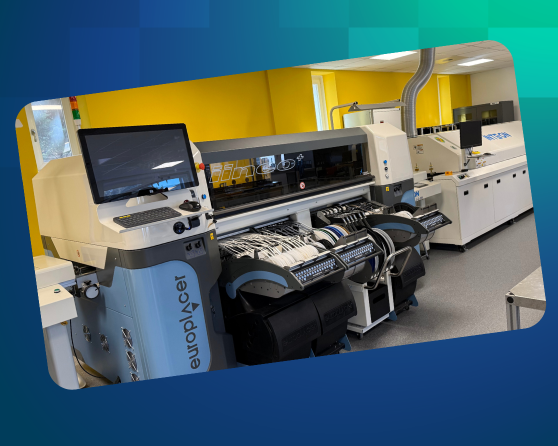
Design to Manufacturing
Why In-House Manufacturing Matters for Technology Companies
In public transport systems and industrial electronics, reliable, long-term performance is not just an advantage, it is an expectation. Solutions must comply with strict industry standards, meet demanding operational requirements, and adapt to continuous technological change.
In this environment, engineering expertise or manufacturing capacity alone is not enough. What truly sets a company apart is its ability to maintain full control over the entire process, from design and development to manufacturing and implementation.
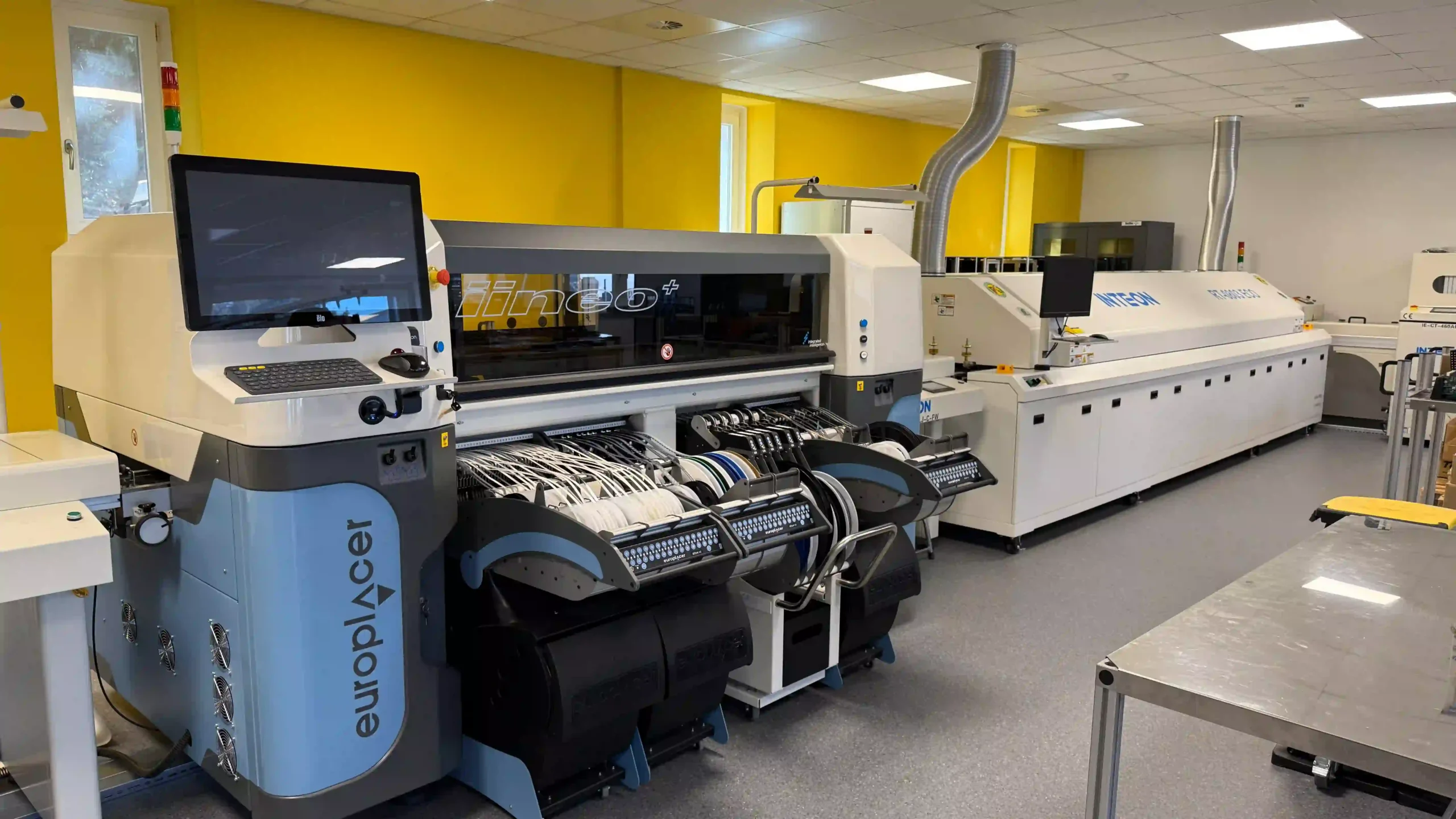
Engineering or Manufacturing?
Many technology companies choose to outsource manufacturing while keeping engineering and product development in-house. Although this may seem efficient in the short term, it often leads to slower response times, more coordination, and increased project risks. As a result, a gap emerges between engineering decisions and manufacturing realities.
With in-house manufacturing, that gap disappears. Engineers gain immediate insight into how their decisions affect production, while manufacturing feedback is quickly incorporated into the development process. This creates a continuous feedback loop that enables faster iterations, reduces errors, and results in more reliable, higher-quality systems.
Faster Innovation and Shorter Development Cycles
In-house manufacturing also significantly accelerates prototyping and testing. Design changes can be implemented in days rather than weeks, which is especially valuable for complex systems that require continuous refinement throughout the development process.
Manufacturing location also has a direct impact on quality. When production takes place in-house, manufacturing, quality control, and testing operate within a single, integrated process. This not only improves product quality but also provides complete traceability throughout the production lifecycle.
This level of control is particularly important for long-life systems, where traceability, maintenance, repairs, or product modifications may be required many years after deployment.
Long-Term Support
The benefits of in-house manufacturing extend well beyond production. By keeping system knowledge within the company, maintenance, software updates, hardware upgrades, and system expansions can be delivered more quickly and efficiently.
This not only streamlines ongoing support but also reduces operating costs and maximises system availability throughout the product lifecycle.
Ultimately, in-house manufacturing determines how much control a company has over the entire product lifecycle. Companies that keep engineering and manufacturing under one roof can respond faster, deliver more predictably, and build stronger, long-term partnerships with their customers.
For more than 35 years, HC Linear has operated on this principle. With in-house manufacturing, an experienced team of engineers and software developers, and expertise spanning design, development, manufacturing, system integration, commissioning, and operational support, we manage every stage of the project lifecycle under one roof.
Planning a new project? Contact us to discover how our end-to-end expertise can support your project from initial concept to long-term operation.
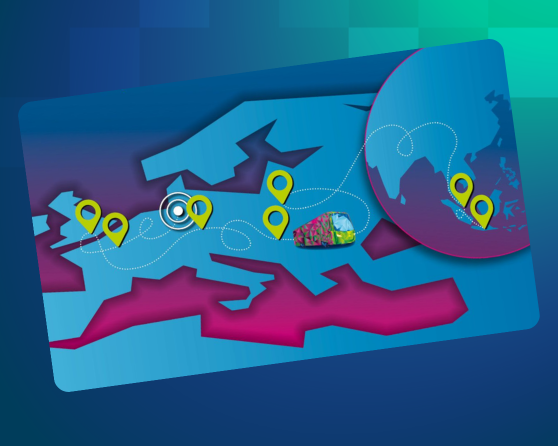
BUS2BUS Roadshow
BUS2BUS 2026: Autonomous Mobility, Electrification and the Future of Bus Transport
The fourth stop of the BUS2BUS Roadshow in Berlin set the strategic tone for BUS2BUS 2026, positioning bus mobility at the center of Europe’s transport transformation. At the first Roadshow stop in Hungary and the Czech Republic, Tamás Móricz, Commercial Director of HC Linear, represented the company in a professional dialogue with an international audience. The Berlin roundtable discussion, moderated by Sustainability Evangelist and Podcast Host Zackes Brustik, brought together Kerstin Kube-Erkens, Director of BUS2BUS at Messe Berlin; Christiane Leonard, Managing Director of the Bundesverband Deutscher Omnibusunternehmen; Dr. Stefan Carsten, Futurist and Curator of the BUS2BUS Future Forum; and Maximilian Rohs, Director Infrastructure & Mobility at PwC Deutschland.
The message emerging from the discussion was clear. Buses are no longer simply a component of public transport. They are a strategic enabler of sustainable, scalable, and digitally integrated mobility systems.
Industry in Structural Transformation
The bus sector is undergoing structural change driven by three interconnected forces: decarbonization, digitalization and automation.
Fleet electrification is accelerating across European markets. Battery electric buses and alternative powertrains are reshaping procurement strategies and operational models. However, large scale deployment depends on parallel investment in charging infrastructure, grid capacity and reliable funding mechanisms. Without scalable depot and opportunity charging solutions, electrification cannot reach full operational maturity.
Autonomous Driving Technology
At the same time, autonomous driving technology is progressing from pilot projects toward scalable deployment. Highly automated buses are increasingly viewed as a long term response to one of the sector’s most pressing structural challenges: driver shortages. In rural and low demand areas especially, automation could expand service coverage while improving operational efficiency.
From Vehicles to Integrated Mobility Systems
A key takeaway from the panel was the shift from product centric thinking to system oriented mobility ecosystems. Future operators will not simply procure vehicles. They will integrate energy management, AI based fleet optimization, digital ticketing and real time passenger information into cohesive mobility platforms.
Regulation, Funding and Investment Security
Technological readiness alone is insufficient. Stable regulatory frameworks and long term funding instruments are essential to ensure investment security. The discussion highlighted the need for coordinated public support schemes to accelerate fleet electrification, infrastructure rollout and digital transformation.
Reducing administrative burden and ensuring alignment between European and national regulation were identified as critical enablers of innovation. Overregulation risks slowing deployment at a time when implementation speed is decisive.
Rural Mobility and Strategic Relevance
Beyond technology, the bus was positioned as a strategic instrument for territorial cohesion. Compared to rail infrastructure, buses offer flexibility, lower capital expenditure and faster deployment cycles. This makes them central to strengthening rural mobility and ensuring affordable access to transport services.
Younger generations increasingly prioritize accessibility and sustainability over private vehicle ownership, reinforcing the long term relevance of bus based mobility solutions.
Looking Ahead to BUS2BUS 2026
BUS2BUS 2026 will take place on 15 and 16 April 2026 at Messe Berlin. The event will occupy two exhibition halls and an outdoor area offering test drive opportunities, with more than 50 vehicles on display. Dedicated formats such as the Future Forum, Partner Stage and the Young Professionals program will complement the exhibition, alongside additional networking opportunities. Designed as a platform for exchange across the entire value chain of the bus and coach industry, BUS2BUS 2026 aims to connect manufacturers, operators, policymakers and technology providers in a focused professional setting.
The Roadshow underscored that the future of mobility will depend on integrated systems, coordinated investment and technological maturity. In this transformation, buses will play a defining role. For technology providers such as HC Linear, this evolving landscape represents both responsibility and opportunity: delivering reliable, high-performance solutions that contribute to the operational resilience and long-term sustainability of next-generation mobility systems.
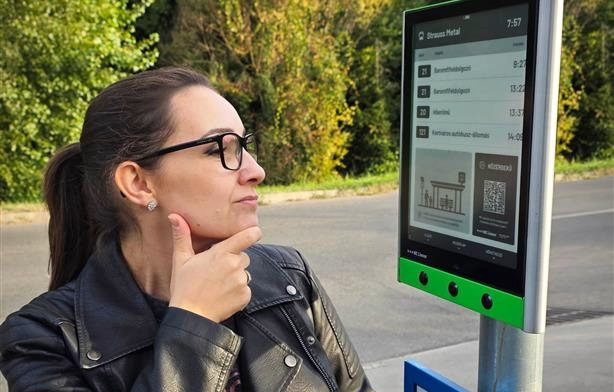
Myths about SmartPage e-paper
4 myths about SmartPage e-paper displays, clarified
Over the past months, we have received numerous positive responses to our SmartPage e-paper passenger information displays. At the same time, some myths and doubts have also appeared, often rooted in misunderstandings. We have collected the most common ones and provide brief explanations to clarify the facts.
“If the sun isn’t shining, it won’t work”
Although the displays can be powered by solar panels, they are not dependent on sunlight. The built-in battery has been designed to ensure reliable operation even during cloudy periods or in winter. Where required, the device can also be connected to the power grid, providing multiple energy options. Another key advantage of e-paper technology is its energy efficiency: the display only consumes power when refreshing content, which keeps operational energy demand to a minimum.
“It won’t last a week before someone damages it”
Durability is often a concern with public displays. SmartPage units are designed for outdoor use, featuring anti-glare safety glass and a robust housing that withstands both harsh weather and vandalism attempts.
Experience shows that passengers value the displays and use them as intended, supporting their long-term operation.
“Older people will not know how to use it”
Digital screens are often assumed to be too complex for seniors. In designing SmartPage, user-friendliness was a top priority. The display features large, easy-to-read characters that remain visible under all lighting conditions. Its classic, oversized navigation buttons are familiar and intuitive, even for those with little experience using digital devices.
In practice, older passengers adapt quickly and come to appreciate the accurate, real-time information provided. We often see passengers helping one another get familiar with the device, which further strengthens acceptance across all age groups.
“It’s unnecessary, everyone has a phone anyway”
Some argue that a good mobile app makes public displays unnecessary. In reality, the two serve different purposes and complement each other. Not every passenger has mobile internet, and many, especially seniors and tourists, prefer not to download apps. Phones can run out of battery, lose signal, or simply be less convenient than a display that provides information instantly.
In public transport, passenger experience is crucial. SmartPage delivers accessible, reliable information that builds trust and makes choosing public transport easier.
Would you like to know more?
Contact us to learn more about how our solutions can help make public transport in your city more reliable and passenger-friendly.
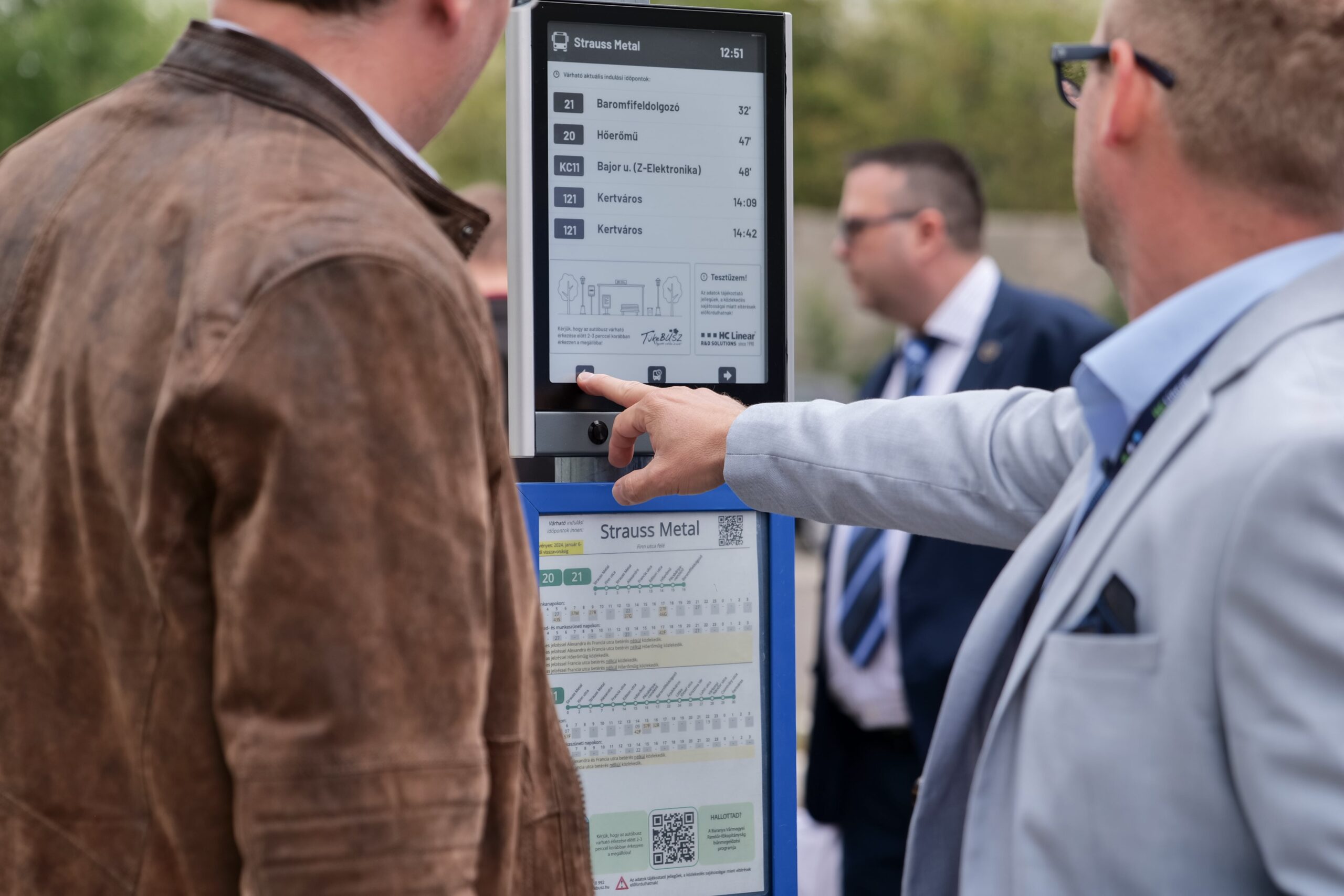
E-paper display
HC Linear Ltd. Advances Sustainable Transportation with E-Paper Solar Energy Utilization
In our pursuit of a greener and more sustainable future, HC Linear is leading the charge in innovation with our latest project focused on e-paper-based solar energy utilization for transportation systems. This pioneering endeavor, spearheaded by our dedicated team, is now in its final stages, marking a significant milestone in our commitment to sustainable technology.
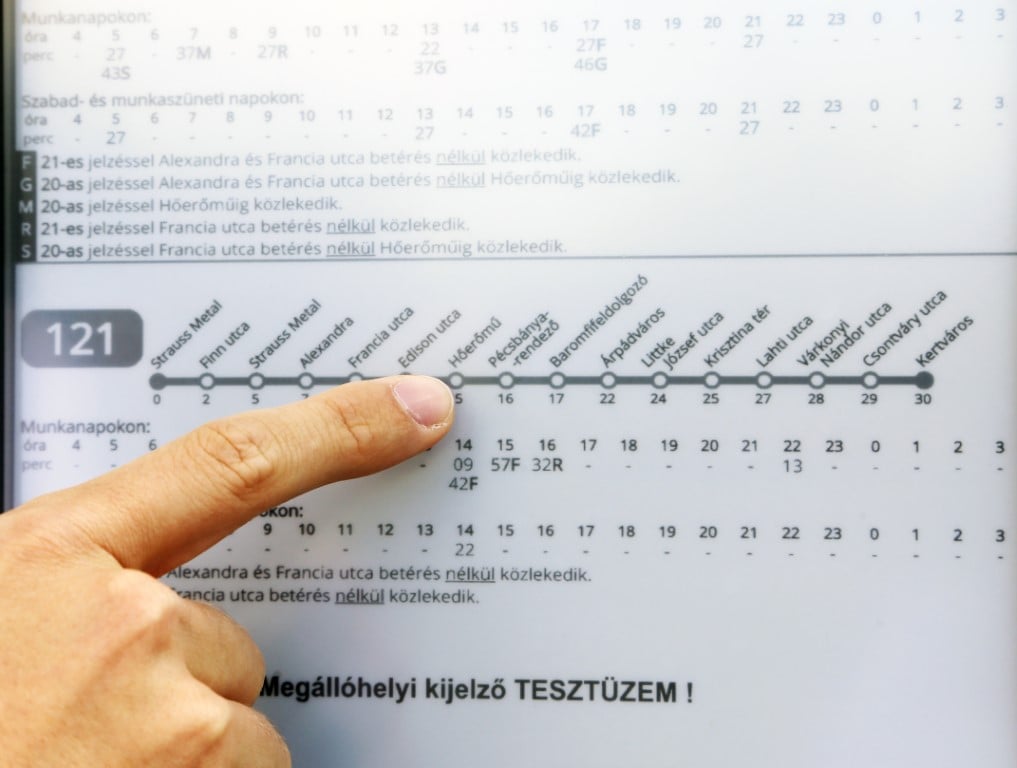
At the heart of this groundbreaking initiative is the integration of e-paper displays powered by solar energy. These displays provide dynamic passenger information, drawing power from solar panel-charged built-in batteries, making them ideal for outdoor use in various conditions. From real-time departure updates to interactive maps and ticketing details, the system offers comprehensive and eco-friendly solutions for commuters.
By harnessing solar energy and modernizing transportation systems, we aim to address the urgent need for greener mobility options. This innovative system not only enhances passenger comfort but also encourages the adoption of environmentally friendly technologies within the transportation sector.
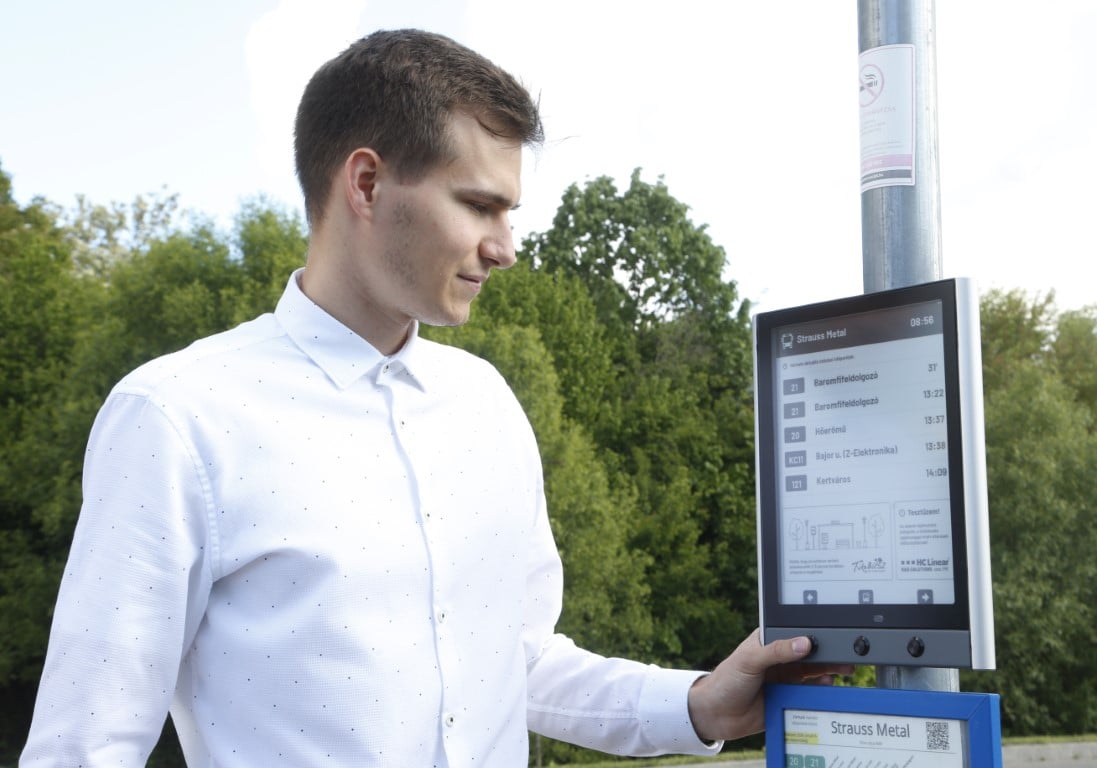
Central to the project is HC Linear Ltd.’s electronic passenger information system, designed to deliver accurate and timely updates to commuters. This system streamlines urban transportation processes, contributing to the overall improvement of city life and environmental sustainability.
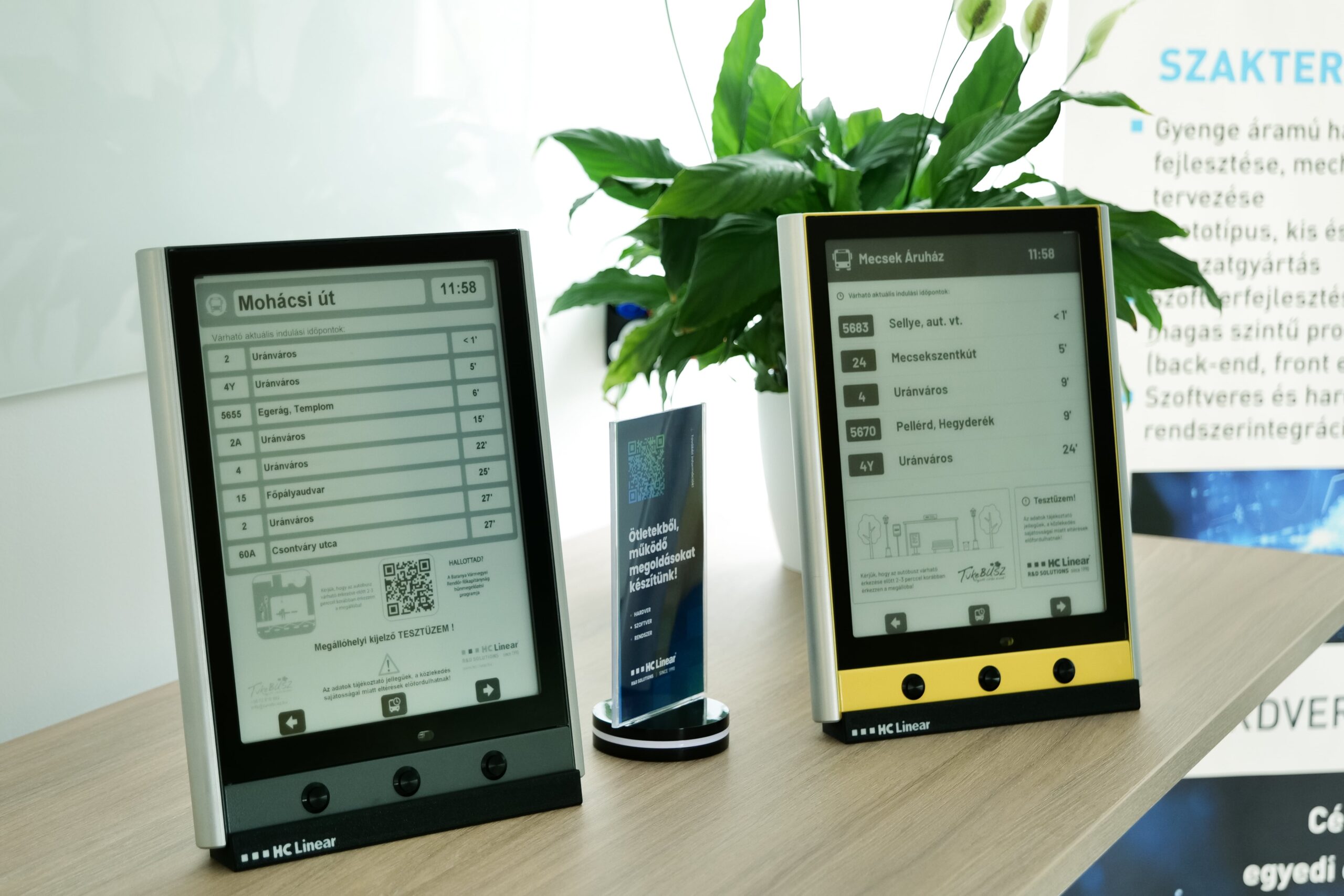
Through the utilization of e-paper displays and solar energy, we are paving the way for more efficient and eco-conscious transportation solutions. Our innovative developments provide residents and visitors alike with improved access to public transportation information, ultimately enhancing urban quality of life and fostering the widespread adoption of sustainable transportation solutions.
You can find more information on our E-paper displays under Products.
See related media coverage online:
https://www.pecsma.hu/egy-pecsi-fejlesztesnek-koszonhetoen-pontosan-tudhatjuk-mikor-jon-a-busz/